
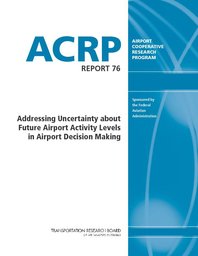
ACRP Report 76: Addressing Uncertainty about Future Airport Activity Levels in Airport Decision Making
Publication Date
2012-10-16Abstract
The management and planning of airports depends heavily on projections of the future requirements of a wide range of airport users and stakeholders (airlines, passengers, other commercial customers, government and regulators, lenders, and so forth) over a long-term horizon. Airport facilities have long life spans of 20 years or more. Investment decisions such as terminal expansion can lock in the airport to a particular service level and operating cost for long periods of time. Forecasts of future airport activity are thus an essential tool for airport planning and financing decisions. These forecasts provide guidance on future passenger, cargo, and aircraft activity that the airport may face that, when compared to existing capacity, helps define future facility, commercial, and financing requirements. An accurate forecast used to drive investment policy creates significant value for the airport and its users. Conversely, an inaccurate forecast can result in poor timing of investment and lock in higher operating and financing costs.
ACRP Report 76 provides a systems analysis methodology that augments standard master planning and strategic planning approaches. This methodology includes a set of tools for improving the understanding and application of risk and uncertainty in air traffic forecasts as well as for increasing overall effectiveness of airport planning and decision making.
Publisher
Transportation Research Board of the National AcademiesCreator
Kincaid, I., et al.Sponsor
Federal Aviation AdministrationCitation
Kincaid, I., Tretheway, M., Gros, S., & Lewis, D. (2012). ACRP Report 76: Addressing Uncertainty about Future Airport Activity Levels in Airport Decision Making. Transportation Research Board of the National Academies, Washington, D.C.